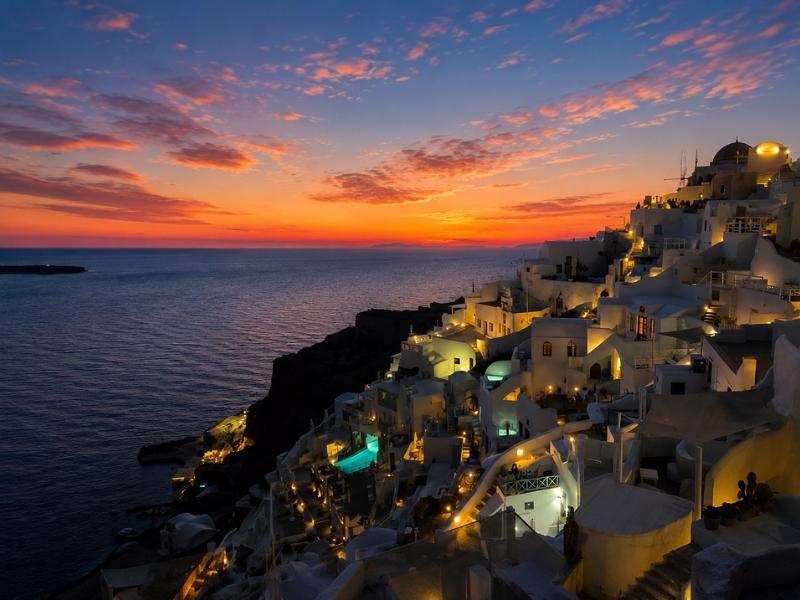
How expensive is Greek island hopping? (2026)
Island hopping can be a shoestring backpacker week or a four-star caldera splurge, on the exact same map. What moves the bill is the season, the number of islands, and how far up the hotel ladder you go.
Greek island hopping costs as much as you let the islands and the season decide. A self-guided package that bundles hotels, ferries and transfers across Athens, Mykonos and Santorini starts at $1,139 per person for seven days. Add islands and climb the hotel ladder and it rises to $2,305 for a nine-day Paros, Naxos and Santorini route and $3,197 for an eleven-day four-star version. Do the same route independently and ferries, island hotels and food land in broadly the same territory in peak summer.
The reason the range is so wide is that island hopping multiplies your two big costs. Every island is another hotel and another ferry leg, so a five-island sprint costs far more than a two-island week even before you touch the hotel grade. That is the lever most people miss when they picture a cheap Greek summer.
How Expensive Is Greek Island Hopping?
Plan on roughly $1,100 to $3,200 per person for a week to eleven days as a bundled package, before flights. The floor is a self-guided two-island week at $1,139; more islands, longer stays and four-star hotels push it to around $3,197. Done independently, the same routes cost broadly the same in peak season, with the planning as your job.
Those are real listed package prices at the anchor points; the space between them is set by island count, hotel grade and season. Before you compare, it helps to see how the routes and ferries fit together, because a tighter sequence means fewer nights and fewer crossings to pay for.
Read the packaged floor as your reference point for the do-it-yourself route too. If a seven-day, two-island hop can be bundled with hotels, ferries and transfers from $1,139, then a self-planned version of the same trip that lands far above that has usually made a hotel-grade or peak-season choice, not been overcharged. The package price is a useful sanity check on any figure you build yourself: well below it and you are cutting corners, well above it and you are buying a more expensive trip than you realised.
Independent hoppers ask for a single per-day figure, and there is not an honest one, because a day on Naxos in May and a day on Santorini in August are not the same purchase. The useful way to budget is by the parts that move: the ferry between islands, the room once you land, and the food and extras on the ground. Break it down that way and the total stops being a mystery.
The wide range is also why island hopping gets an unfair reputation as either dirt cheap or ruinously expensive, depending on who you ask. Both camps are right about their own trip. The backpacker on quieter islands in May and the couple in a caldera suite in August are describing the same activity at opposite ends of a very long ladder. Knowing which rung you intend to stand on is the whole budget.
What Actually Drives The Cost Of Island Hopping?
Four things move an island-hopping budget: the season, the number of islands, the hotel grade, and ferry type. Peak July and August lift island hotel rates the most; each extra island adds a hotel and a crossing; caldera-view rooms cost multiples of inland ones; and high-speed catamarans cost more than conventional ferries on the same route.
Season is the strongest single factor, and it lands almost entirely on hotels. The same room in Oia is a different animal in August than in May. Ferry type is the lever travellers forget: the fast boats save hours but cost more, and you can compare the two for any route on a ferry booking site. Choosing between them is really a question of how you want to move between the islands. The table shows how the same costs shift between peak and shoulder.
| Cost on a self-planned island-hop | Peak (Jul to Aug) | Shoulder (May, Sep) |
|---|---|---|
| Island hotel, per night | Highest, books months ahead | Lower, far more choice |
| Fast ferry between islands | Fixed fare, sells out early | Same fare, easy seats |
| Food and drink per day | Higher on Santorini and Mykonos | Similar prices, quieter tables |
Notice that only the hotel line really swings with the season; the ferry fare is roughly the same in May as in August, it just sells out earlier in peak. That is why timing saves you money on rooms, not on crossings, and why the island you sleep on matters more to the budget than the boat you take to reach it.
How Much Do The Ferries Between Islands Cost?
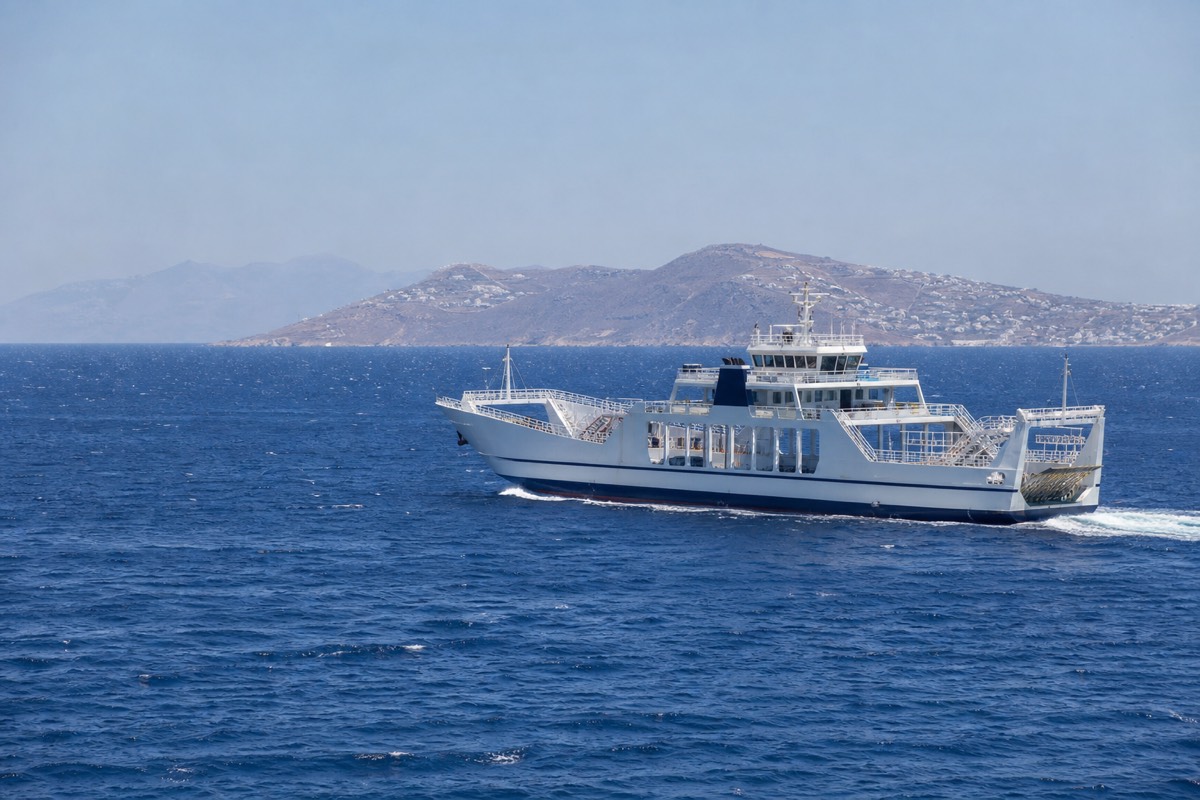
Ferry fares depend on the route, the boat and the season, and the biggest single factor is boat type: high-speed catamarans cost more than the slower conventional ferries on the same crossing, and cars cost extra again. Rather than trust a figure that dates, check the live fare for your exact date and route before you plan. In a package the ferries are already prepaid.
The honest advice on ferry prices is to look them up rather than take a number on faith, because they shift with demand and fuel. What is stable is the shape of the choice: pay more and cross faster on a catamaran, or pay less and take the steadier conventional ship. The table lays out what actually moves a ferry fare.
| What moves the fare | Cheaper | More expensive |
|---|---|---|
| Boat type | Conventional Blue Star ferry | High-speed catamaran |
| Route length | Short Cyclades hops | Long crossings to Crete or the Dodecanese |
| Season and timing | Off-peak, booked early | Peak weekends, booked late |
| Vehicle | Foot passenger | Bringing a car |
On a bundled package none of this is your problem: the crossings are chosen, prepaid and locked to the right dates. If you are hopping independently, reserve the fast boats early in summer, because that is where the do-it-yourself route can quietly get expensive, and read when to reserve the ferries before the popular sailings fill.
One honest caveat on ferries and budget: the crossings are a smaller share of the total than most people expect. It is the hotels that dominate, so a traveller who obsesses over saving a little on the boat while booking a caldera-view room in August has aimed at the wrong line. Take the cheaper conventional ship where it suits you, but do not let the ferry choice distract from the decision that actually moves the budget, which is where you sleep.
How Much Do Island Hotels And Food Cost Per Day?
The daily cost is set mostly by which island you sleep on. Santorini and Mykonos sit at the top for both rooms and dinner, Paros and Naxos are noticeably gentler for the same quality, and Athens is cheaper again. Food scales the same way: a taverna on a quieter island costs a fraction of a caldera-view table in Oia.
Rather than a single per-day number that would mislead, think in island tiers. The tier you pick for each night, not the abstract idea of "island hopping", is what your daily spend really tracks. The table sorts the usual hopping islands by how they hit a daily budget.
| Where you sleep | Room cost tier | Dining and extras |
|---|---|---|
| Santorini, Mykonos | Highest, caldera and beach-club premium | Priciest tables, book sunset spots ahead |
| Paros, Naxos, Syros | Mid, strong value for the quality | Good tavernas at gentler prices |
| Athens (start and end) | Lower, wide range | Cheapest of the trip, huge choice |
This is why swapping one Santorini night for an extra night on Paros or Naxos quietly lowers a whole trip's cost while barely changing the experience. The quieter Cyclades deliver the same whitewashed lanes and clear water without the caldera premium, and a route like a nine-day Paros, Naxos and Santorini route is built around exactly that balance.
A sensible pattern is to treat Santorini as the finale rather than the whole trip. Two nights there for the caldera and the sunset, framed by longer, cheaper stays on Paros, Naxos or Syros, gives you the postcard without paying its nightly rate for the entire week. You still see the island everyone comes for; you just stop letting its hotel prices set the cost of every other night on the map.
What Do Island-Hopping Packages Cost By Length?
Listed island-hopping packages run from $1,139 for a self-guided two-island week to $3,197 for an eleven-day four-star hop and $2,289 for a fifteen-day, four-island route. The gap between them is islands and hotel grade, not a different level of service. All prices are per person and cover hotels, ferries and transfers.
These are the real bundled prices, all covering hotels, ferries and transfers. Reading them side by side shows how much of the difference is simply more nights and a higher hotel tier rather than a fundamentally different trip.
| Package | Islands | Hotels | Price, from |
|---|---|---|---|
| Self-guided, 7 days | Mykonos, Santorini | Comfortable 3-star | $1,139 |
| 9-day island hopping | Paros, Naxos, Santorini | 2 nights each, 3 to 4-star | $2,305 |
| 11-day semi-guided | Mykonos, Paros, Naxos, Santorini | 4-star | $3,197 |
| 15-day self-guided | Syros, Mykonos, Santorini, Crete | Comfortable | $2,289 |
The nine-day route is the sweet spot for many: three islands, two nights on each, and a price well below the four-star eleven-day version. Where the eleven-day four-star island-hopping tour costs more, most of that difference is hotel grade and two extra nights, not a fundamentally different trip. And the fifteen-day route proves the point in reverse: four islands including Crete for less than the eleven-day four-star trip, because its hotels sit a grade lower.
That inversion is the single most useful thing to notice on the whole table. More days does not automatically mean more money; hotel grade outranks length. If your instinct is that a longer trip must cost more, the fifteen-day route quietly corrects it, and points at the real lever for anyone budget-minded, which is to trade a hotel grade rather than to cut nights off the trip.
Is It Cheaper To Hop DIY Or On A Package?
For one or two islands in shoulder season, planning it yourself is often a little cheaper. For three or more islands in peak summer, a package frequently matches or beats the do-it-yourself total, because the operator books island hotels and ferries in volume before the summer spikes. The consistent saving of a package is the planning time, not always the money.
The catch with the do-it-yourself route is that its cost depends on booking early. Leave Santorini and Mykonos hotels until spring for a July trip and you pay scarcity prices; the package rate was set months before. The table sorts when each route wins.
| Your trip | Usually cheaper DIY | Package often wins |
|---|---|---|
| One or two islands, shoulder season | Yes, and easy to plan | Only for the time saving |
| Three-plus islands, peak summer | Rarely, if booked late | Often matches or beats on total |
| Four-star hotels, popular islands | Hard to match last minute | Held in the operator's allocation |
To keep a self-planned hop cheap, book ahead and favour the quieter islands. If you would rather not price every leg yourself, a self-guided package such as a self-guided Athens, Mykonos and Santorini package folds the ferries and hotels into one number set months before the summer spike.
The comparison people most often get wrong is counting only the package price against only the sum of hotel and ferry quotes, and declaring the package "expensive". That leaves out the transfers, the coordination hours, and the risk premium of holding peak-season rooms yourself. Add those back honestly and the two totals converge on a multi-island summer trip. The package is not charging you extra for the islands; it is charging you for absorbing the parts of island hopping that cost time and nerve rather than money.
How Much Does A Cheap Versus Comfortable Versus Four-Star Hop Cost?
Three tiers cover most island-hoppers. A lean shoulder-season hop across two or three quieter islands sits near the bottom of the range; a comfortable summer version with mixed hotels lands in the middle; a four-star, popular-island hop reaches the top. The tier is set mostly by hotel grade and island choice, not by how many crossings you take.
Thinking in tiers is more useful than chasing one average price, because two hops with the identical island list can sit a thousand dollars apart on hotel grade alone. The table maps the three tiers against the real listed packages so you can see which one your instincts point at.
| Tier | What it looks like | A package near it |
|---|---|---|
| Lean | Shoulder season, quieter islands, comfortable 3-star, conventional ferries | 7-day self-guided, from $1,139 |
| Comfortable | Summer, three islands, two nights each, mixed 3 to 4-star | 9-day Paros, Naxos, Santorini, from $2,305 |
| Four-star | Four islands, premium hotels, a guided day or two | 11-day semi-guided, from $3,197 |
The gap between the lean and the four-star tier is real money, roughly a doubling, but almost none of it is the "hopping" itself. It is the hotel grade and the choice of Santorini and Mykonos nights over Paros and Naxos ones. Decide the tier first and the rest of the budget falls into place, and if you are still unsure whether to bundle it at all, whether a package is worth it weighs the same trade for a multi-island trip.
How Do You Island-Hop Greece For Less?
Four moves cut the bill without cutting the trip: travel in May or September, keep it to two or three islands, favour Paros and Naxos over Santorini and Mykonos, and take the conventional Blue Star ferries where the timetable allows. Together they lower rooms, crossings and dinners at once, which is most of an island-hopping budget.
Travel in May or September, when island hotels drop but the sea stays warm. Keep it to two or three islands, since each one adds a hotel and a crossing. Favour Paros and Naxos over Santorini and Mykonos, where both rooms and dinner cost less. And take the conventional Blue Star ferries where the timetable allows, trading an hour or two for a lower fare.
Timing matters as much as island choice, so it is worth checking which is the best month to island-hop before you fix dates, and deciding which islands to choose so you are not paying the caldera premium for nights that a quieter island would cover just as well. If you are also pricing the whole week, see how a seven-day Greece budget breaks down across flights, food and extras, and if a longer route tempts you, a fifteen-day, four-island route spreads four islands including Crete across two weeks. Handled as a package, the whole hop arrives with the ferries, hotels and transfers already priced through Greece Tour Packages, which is the one reliable way to lock a peak-season budget before the rooms spike.